

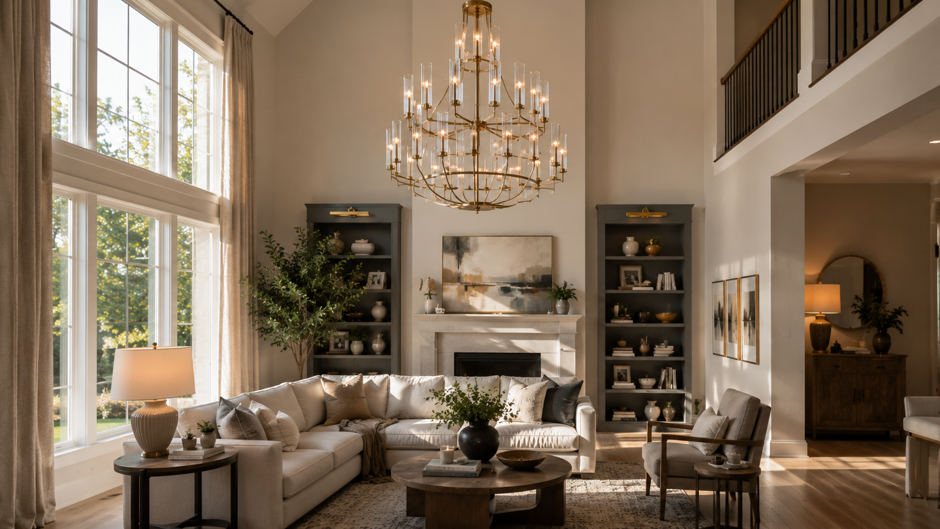
Walk into a room with twelve-foot ceilings, and you’ll feel it immediately. Not the height itself, but the emptiness. All that vertical space is doing nothing but making your furniture look smaller, and your decor feel unfinished. It’s a problem I see constantly in open-concept homes, older builds with generous proportions, and those converted lofts everyone loves until they try to decorate them.
Here’s what most people miss. The fix isn’t about filling every inch of wall space or piling on more floor decor. It’s about drawing the eye upward with intention. When you choose the right overhead fixture, something substantial enough to hold visual weight, the whole room shifts. Suddenly, that awkward vertical gap feels purposeful. This is where traditional chandeliers earn their place in modern homes, not as outdated relics, but as functional anchors that lend timeless structure to spatial proportions.
You don’t need a designer’s budget or a complete renovation. You need one smart focal point that does the heavy lifting for you. The right piece changes how a room reads, how comfortable it feels, and how pulled together it looks when someone walks through the door.
The Height Problem Most Decorating Advice Ignores
Standard decorating rules fall apart when ceilings stretch past nine feet. Picture frames feel tiny. Table lamps disappear. Paint colors that looked warm in the store now feel cold and distant because there’s too much space between your eye level and where the room actually ends.
I learned this the hard way in my own living room. No amount of gallery walls or layered textiles made the space feel cohesive. The problem was overhead. I needed something substantial enough to bridge the visual gap between where people sit and where the room stops. A well-chosen fixture creates that connection naturally. It gives your eye a resting point between the furniture zone and the ceiling line, which is exactly what makes a tall room feel intentional instead of hollow.
According to a 2025 study from the American Lighting Association, rooms with ceiling heights above ten feet benefit most from fixtures that hang at least 30 inches from the ceiling. That measurement matters. Too close and the fixture vanishes. Too bold, and it commands the room instead of complementing it.
What Actually Works In Real Rooms
Size matters more than style. A fixture that’s too small for the space reads as an afterthought, no matter how expensive it is. You want something with presence but not drama. Think substantial forms, materials that catch light naturally, like glass or brass, and a silhouette clear enough to register from across the room.
Here’s a scenario that plays out constantly. Someone buys a beautiful fixture online, hangs it in a two-story entryway, and it looks like a pendant light that got lost. The piece isn’t wrong; the scale is. For rooms with ceilings between ten and fourteen feet, you’re looking at fixtures with a diameter of at least 24 to 30 inches. Go bigger if the room is wide open or if it’s a primary gathering space.
Placement height is where people second-guess themselves. Over a dining table, you want 30 to 36 inches of clearance between the tabletop and the bottom of the fixture. In entryways or living rooms without furniture directly beneath, aim for at least seven feet of clearance from the floor. That keeps the fixture visible without creating a head-bumping hazard or blocking sightlines across the space.
The Details That Make Or Break The Look
Material choice affects how a fixture reads in daylight versus evening. Metal frames with clear or lightly tinted glass work across different lighting conditions without feeling too heavy or too delicate. Opaque shades or solid metal designs create stronger silhouettes but can feel imposing if the room doesn’t have enough natural light to balance them during the day.
Think about what else is happening in the room. If your furniture is low profile and modern, a fixture with clean lines and minimal ornamentation keeps everything cohesive. If the space leans traditional or you’ve got architectural details like crown molding or wainscoting, fixtures with more structure and layered elements feel at home.
One detail that’s easy to overlook is the canopy, the part where the fixture mounts to the ceiling. In rooms with high ceilings, that mounting point is visible and matters. A canopy that’s too small or too plain makes the whole installation look temporary. Choose one that’s proportional to the fixture size and finished in a way that complements the rest of the piece.
Making It Work With What You Already Have
You don’t need to redecorate the entire room around a new fixture. The goal is cohesion, not matching. If your space has warm wood tones, look for fixtures with brass, bronze, or aged metal finishes. Cool-toned rooms with grays and whites pair well with polished chrome, brushed nickel, or matte black frames.
Layer your lighting instead of relying on one source. A strong overhead fixture sets the tone, but you still need task lighting in seating areas and ambient lighting from table or floor lamps to make the space functional after dark. When you’re working with a high ceiling chandelier, the overhead piece becomes the visual anchor while other light sources handle the practical work of illuminating specific zones.
Scale the rest of your decor to match. If you’ve added a substantial fixture overhead, your furniture arrangement should feel equally grounded. Low, scattered pieces make the room feel bottom-heavy. Group seating into cohesive zones. Use area rugs to define spaces. Add tall plants or floor mirrors to activate the middle height range of the room.
Three Scenarios Where This Changes Everything
Open entryways. That double-height entry hall that felt impressive when you moved in, but now just feels empty? A properly scaled fixture gives arriving guests something to focus on besides the blank walls and awkward vertical space. Choose something with enough presence to read immediately from the front door. Position it so it’s centered over the main entry point, not tucked off to one side where it loses impact.
Vaulted living rooms. Rooms with sloped or vaulted ceilings need fixtures that work with the architecture rather than fighting it. Hang the piece at the room’s lowest functional height, which keeps it accessible for cleaning and bulb changes while still taking advantage of the volume overhead. Avoid trying to fill the peak of the vault. Let the fixture sit lower and use the ceiling height as negative space that makes the room feel larger.
Dining spaces with drama. If your dining area has tall ceilings, you’ve got built-in drama that most people pay extra to create. Use it. A fixture with multiple tiers or layered arms draws the eye up while defining the dining zone clearly. Keep the table and chairs simple so the overhead piece can be the statement element without competing for attention.
What To Watch Out For
Cheap fixtures look cheap at any height, but they’re especially obvious in rooms with high ceilings where every angle is visible. If the budget is tight, invest in one quality piece rather than multiple mediocre ones. The difference shows in how the materials age, how the finish holds up, and how the overall construction reads from below.
Installation isn’t a DIY project if you’re working with high ceilings. Hire an electrician who has the equipment and experience to handle the job safely. A fixture that’s improperly balanced or inadequately supported becomes a hazard, not a design choice.
Dimmer switches are non-negotiable. You need control over how much light the fixture throws at different times of day. Bright and functional for daytime tasks, dialed down for evening ambiance. That flexibility is what makes a statement fixture livable instead of just showy.
FAQ
How do I clean a fixture I can’t easily reach?
Use an extension duster with a microfiber head for regular maintenance. For deeper cleaning twice a year, hire a professional or use a stable ladder with a spotter. Never spray cleaner directly onto the fixture. Dampen a cloth and wipe each element individually to avoid moisture damage to electrical components.
Can I use LED bulbs in an older style fixture?
Yes, and you should. LED bulbs are available in warm color temperatures that mimic traditional incandescent lighting. They last longer, use less energy, and produce less heat, which is better for both the fixture and your ceiling. Check the fixture’s maximum wattage rating and stay within that limit even though LEDs draw less power.
What if my ceiling is too high for standard chain or rod lengths?
Most quality fixtures come with adjustable downrods or chains that can be customized to your ceiling height. You can order extension rods from the manufacturer or a lighting supply store. Make sure any extensions match the finish of your fixture and are rated to support its weight. Don’t improvise with hardware store parts that aren’t designed for the load.
The Difference One Choice Makes
Rooms don’t feel finished by accident. They feel finished when every major element earns its place and does something useful. The right overhead fixture in a room with a generous ceiling height isn’t just about light. It’s about proportion, balance, and giving the space a visual center that makes everything else fall into line.
You’ll know when it’s right because the room stops feeling like a project and starts feeling like a place you actually want to be. That’s not something more throw pillows or another coat of paint can fix. It’s about making one deliberate choice that changes how the whole space works together.


